Overview
In capital-intensive transactions, value is not determined solely by projected performance.
It is determined by:
- capital structure behavior
- timing of execution
- and constraints on exit
This analysis evaluates what value is actually realizable under real-world conditions.
When It Matters
Most relevant when:
- Refinancing risk exists
- Capital structure is unstable
- Exit timing is uncertain
- Market liquidity is limited
- Transaction pricing lacks reliability
Analytical Framework
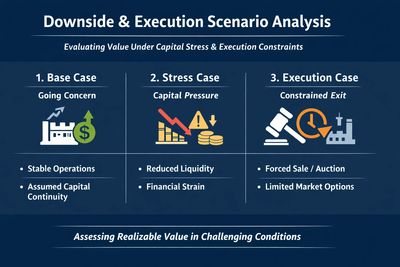
We evaluate value across three conditions:
1. Base Case — Going Concern
- Normalized operations
- Assumed capital continuity
2. Stress Case — Capital Pressure
- Reduced liquidity
- Delayed execution
- partial underperformance
3. Execution Case — Constrained Outcome
- Forced or accelerated exit
- limited buyer universe
- pricing under execution pressure
What This Addresses
- Realistic exit value vs theoretical value
- Recovery expectations under capital stress
- Downside exposure prior to transaction commitment
- Negotiation positioning under imperfect conditions
Role in Transaction Advisory
This analysis is embedded within transaction advisory to:
- test acquisition pricing
- support negotiation strategy
- evaluate hold vs exit decisions
- identify value breakdown points before execution
Core Principle
Value is not what a model produces.
It is what can be executed under constraint.