Independent Judgment for Complex Valuation
Cost Segregation for Data Centers and QPP
Engineering-Informed | Appraisal-Disciplined | Tax-Advisor Coordinated
Alpha Consulting US provides cost segregation and capital-recovery studies for data centers, advanced manufacturing facilities, energy infrastructure, industrial properties, and other capital-intensive assets nationwide.
These facilities cannot be analyzed reliably using generalized building percentages or template-driven classifications. Their depreciation treatment depends on how electrical, mechanical, production, cooling, control, and site systems function within the overall operation.
Our work combines engineering-based asset identification with appraisal-based cost allocation to produce transparent and supportable depreciation classifications.
Cost Segregation as Capital Classification
A cost segregation study identifies qualifying components that may be depreciated over shorter recovery periods rather than as part of a 39-year nonresidential building.
Depending on their function and applicable tax guidance, components may be classified as:
- Tangible personal property under IRC §1245
- Land improvements
- Qualified improvement property
- Nonresidential real property under IRC §1250
- Qualified Production Property under IRC §168(n), when all statutory requirements are satisfied
- Nondepreciable land
- Separately identifiable intangible or other capital assets, when applicable
The objective is not to maximize short-life property mechanically. It is to reconcile the total depreciable basis and classify each material component according to its actual function, supporting documentation, and applicable authority.
Data-Center Cost Segregation
Data centers are specialized infrastructure platforms in which electrical capacity, cooling, redundancy, security, and network connectivity drive both capital investment and operating performance.
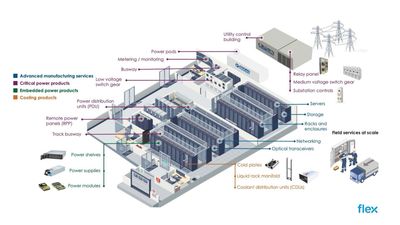
A data-center cost segregation study may require analysis of:
- Utility service and electrical distribution
- Substations, transformers and switchgear
- Uninterruptible power-supply systems
- Backup generation and fuel systems
- Cooling and heat-rejection systems
- Dedicated controls and monitoring systems
- Security and access-control systems
- Equipment-support structures
- Specialized cabling and communications infrastructure
- Site power, drainage, paving, fencing and related improvements
- Administrative, common-area and conventional building components
Classification depends on ownership, design, permanency, functional use, and the relationship of each component to the building or operating equipment. Similar-looking assets may receive different treatment when their functions differ.
Data Centers and QPP Are Not Automatically the Same
A data center does not qualify as Qualified Production Property merely because it is capital-intensive or consumes substantial power. A conventional colocation, cloud, or computing facility generally provides services rather than manufacturing, producing, or refining tangible personal property.
Accordingly, a data-center study normally focuses on the proper separation of short-life tangible property, land improvements, qualified improvement property, and conventional nonresidential real property.
QPP should be considered only when a facility, or a clearly identifiable portion of it, is directly connected to an activity satisfying the statutory definition of qualified production. The determination should be made with the taxpayer’s legal and tax advisers.
Qualified Production Property under IRC §168(n)
Qualified Production Property is generally qualifying nonresidential real property used as an integral part of a qualified production activity in the United States. Subject to the statutory requirements and election, qualifying basis may be eligible for a 100% special depreciation allowance.
Qualified production activities generally involve the manufacturing, production, or refining of qualifying tangible products. Eligibility is based on actual production use—not simply industrial zoning, building design, project size, or the owner’s description of the facility.
QPP is distinct from the machinery and equipment used inside the building. Cost segregation remains necessary to separate:
- Production machinery and tangible personal property
- Process-specific utilities and support systems
- Qualifying portions of nonresidential real property
- Offices and administrative areas
- Research and development areas
- Warehousing and distribution areas
- Parking, lodging, sales and other excluded functions
- Land and qualifying land improvements
Areas that do not directly satisfy the production-use requirements should not be included merely because they are located within the same industrial facility.
QPP Functional-Boundary Analysis
A defensible QPP analysis requires identification of the physical and operational boundaries of qualified production activities.
Our analysis may include:
- Review of site plans, construction drawings and process-flow information
- Identification of production and nonproduction areas
- Analysis of how structural and building systems support production
- Allocation of shared systems between qualifying and excluded uses
- Reconciliation of potentially qualifying basis to total project cost
- Review of construction, acquisition and placed-in-service timing
- Documentation of the expected qualified use
- Coordination with the client’s CPA and tax counsel concerning the election
QPP eligibility is subject to statutory timing and continued-use requirements. Delayed commissioning, insufficient documentation, changes in use, or failure to sustain qualified production can create recapture and examination exposure.
Industrial and Advanced-Manufacturing Facilities
For manufacturing and production facilities, we analyze the interaction among the building, production equipment, and supporting infrastructure.
Common areas of analysis include:
- Production-specific electrical distribution
- Process piping, compressed air, gas and steam systems
- Specialized ventilation and environmental systems
- Equipment foundations and structural supports
- Conveyance and material-handling systems
- Automation and process-control infrastructure
- Clean rooms and controlled production environments
- Utility corridors, service yards and site improvements
- Production, warehouse, office and research-area allocations
The analysis follows economic and operational function rather than architectural appearance alone.
Other Capital-Intensive Assets
Our cost segregation capabilities also extend selectively to:
- Energy and power infrastructure
- Renewable-energy facilities
- Logistics and distribution properties
- Specialized industrial real estate
- Hospitality and healthcare facilities
- Acquired, newly constructed, renovated or expanded properties
For Alpha Consulting US, the principal emphasis is on complex assignments where engineering systems, capital allocation, valuation judgment, and documentation quality materially affect the result.
Our Methodology
1. Preliminary Feasibility Review
We review the property, ownership history, placed-in-service date, estimated depreciable basis, available documentation, anticipated holding period, and potential applicability of bonus depreciation or QPP.
2. Documentation and Basis Reconciliation
Relevant information may include:
- Closing and acquisition records
- Construction contracts and change orders
- Contractor payment applications
- Fixed-asset ledgers
- Architectural, civil, electrical and mechanical plans
- Equipment schedules
- Appraisals and property-tax records
- Site and building-area information
- Prior depreciation schedules
- Production-process and placed-in-service documentation
Total allocated costs are reconciled to the capitalized basis supplied or approved by the client and its tax adviser.
3. Engineering and Functional Analysis
We determine how the principal systems are designed, installed, and used. Classification is based on function, integration, permanency, and available supporting evidence.
4. Appraisal-Based Allocation
When detailed actual costs are unavailable, recognized appraisal and cost-estimating techniques may be used to allocate or estimate component costs. Nondepreciable land and depreciable site improvements are separately analyzed.
5. Asset Classification and Quality Control
Assets are assigned to the applicable recovery categories, reconciled to total basis, and reviewed for consistency. QPP, bonus depreciation, and other elections are separately identified rather than assumed.
6. Written Report
The final report ordinarily includes:
- Executive summary
- Property and project description
- Sources of information
- Methodology
- Asset classifications and supporting rationale
- Cost and basis reconciliation
- Depreciation-category schedules
- Photographic or technical documentation, when applicable
- Assumptions and limitations
New Construction, Acquisitions and Retrospective Studies
A study may be performed:
- During construction to improve cost documentation
- When a facility is placed in service
- Following an acquisition
- After a major renovation, expansion or retooling
- Retrospectively for property placed in service in an earlier year
For a retrospective study, the taxpayer’s CPA determines the appropriate tax-return treatment, including whether a depreciation-method change and Form 3115 are required.
Coordination With Purchase Price Allocation
Cost segregation and purchase price allocation serve different purposes.
Purchase price allocation determines the value assigned among acquired real property, tangible personal property, identifiable intangible assets, and goodwill. Cost segregation classifies the applicable tax basis among depreciation recovery categories.
When both services are required, the analyses should be coordinated so that land, buildings, equipment, site improvements, and other assets are treated consistently without duplication.
Professional Coordination and Limitations
Alpha Consulting US provides engineering-informed cost analysis, appraisal-based allocation, and depreciation-classification support. The taxpayer and its CPA or tax counsel remain responsible for tax elections, return preparation, legal conclusions, and determining the ultimate tax treatment.
QPP eligibility and bonus-depreciation treatment should be evaluated using the law applicable to the taxpayer, property, construction or acquisition date, placed-in-service date, and actual operating use.
Request a Preliminary Review
Before proposing a complete study, we conduct a preliminary review of the project scope, available records, depreciable basis, and potential classification issues.
For data centers, manufacturing facilities, and other capital-intensive projects, early review can improve documentation before construction records become fragmented or operational functions change.
Contact Alpha Consulting US to discuss a cost segregation or Qualified Production Property assignment.